Distractor Analytics: How to Spot Common Misconceptions in Your Assessments
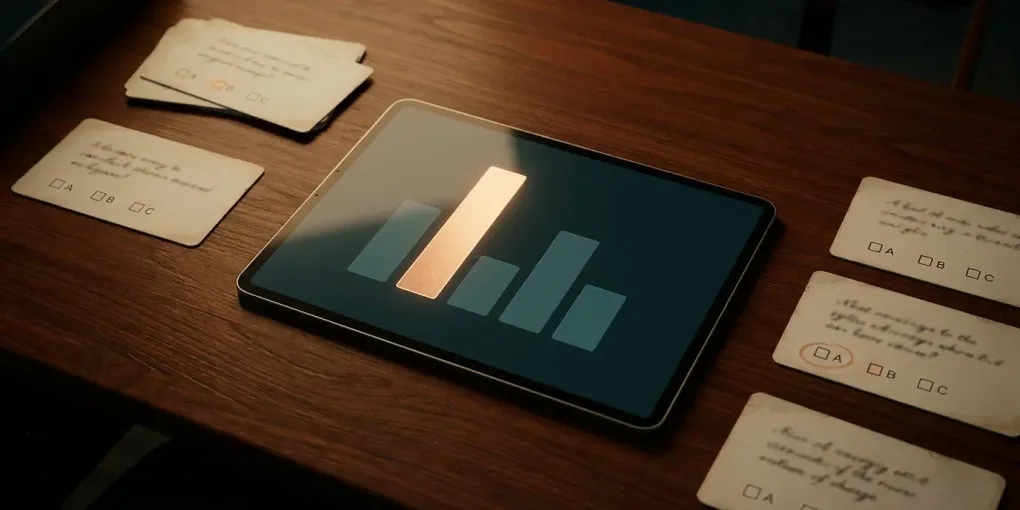
Distractor analytics answers a specific question: which wrong answers do your students choose most often, and what does that tell you about their understanding? In CraftQuestAI, after grading an exam assigned to a class, you can see which distractors attract the most wrong answers and act accordingly.
What is a distractor?
A distractor is an incorrect but plausible option in a multiple-choice question. A good distractor separates students who understood the concept from those who only half-memorized it. A bad distractor confuses almost everyone or is obviously absurd.
How to read the analytics in the classroom
When 60% of the class gets it right but 30% pick the same wrong option, you have three hypotheses:
- Conceptual confusion: the topic wasn’t clear (e.g., mixing up mitosis and meiosis).
- Poorly worded question: the wording pushes toward the mistake.
- Too seductive a distractor: the wrong option looks more correct than the valid answer.
Review the question in the context of the material you uploaded. If CraftQuestAI’s automatic explanation doesn’t match your judgment, edit the question before reusing it.
Practical actions based on the pattern
| Pattern | Recommended action |
|---|---|
| One distractor dominates the mistakes | Review that concept in class |
| Several distractors spread out | Question possibly ambiguous; rephrase it |
| Mostly correct answers, few mistakes | Valid question; keep it or raise the difficulty |
| Almost everyone gets it wrong | Question too hard or outside the syllabus |
Fitting it into your assessment workflow
This analytics feature fits into the full workflow we describe in the guide to AI assessments for teachers: you generate questions from a PDF, assign them to the class, collect results, and improve the question bank for next term.
Unlike gamification tools like Kahoot, where the focus is live participation, here the goal is formative and summative assessment with actionable data.
Honest limitations
The analytics apply to formats with defined options (multiple choice, true/false). For short answers, the analysis is different. It also doesn’t replace a one-on-one conversation with a student who’s still confused.
Start using analytics in your classes: CraftQuestAI for teachers.